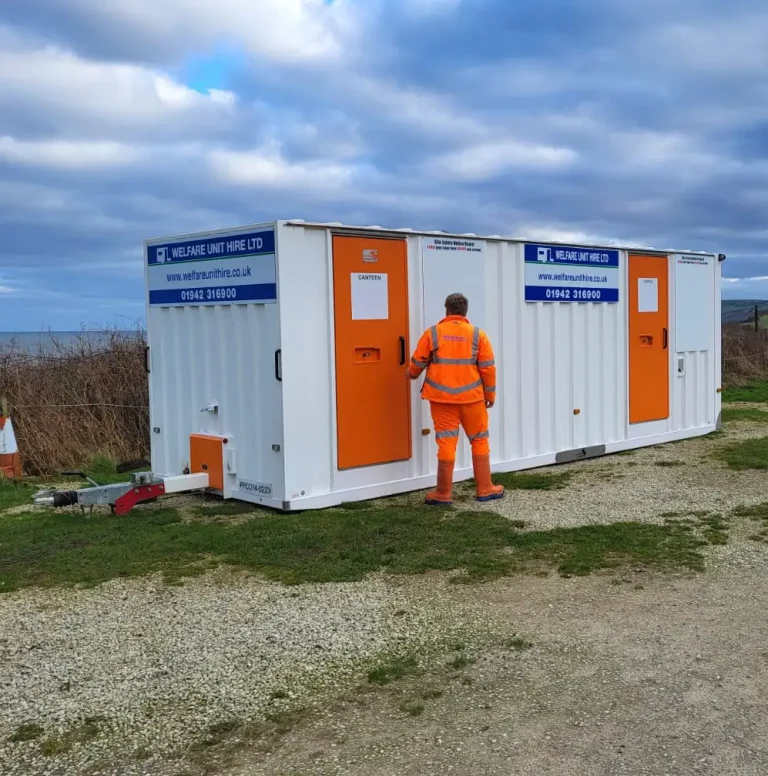
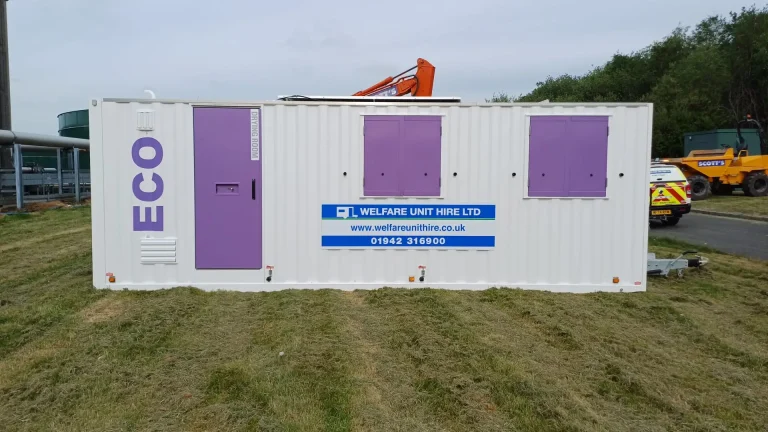
How highways, water, power and telecoms contractors keep compliant welfare within reach of a crew that never stays in one place for long.
A housing site stays put for a year. A gas main replacement, a fibre rollout or a carriageway resurfacing scheme does not. The gang might work 300 metres of road this week and be half a mile further on the next, and the legal duty to provide toilets, washing, rest and drying facilities moves with them. That is why welfare unit hire for utilities and civil engineering work is a different job from dropping a cabin in a fixed compound. The unit has to keep up.
This guide covers what linear works demand from a welfare unit, how to plan around traffic management, and how our Planet Power range is set up to follow the job across the North West.
AT A GLANCE
Welfare duties under CDM 2015 apply to street works and linear schemes just as they do to a fixed site.
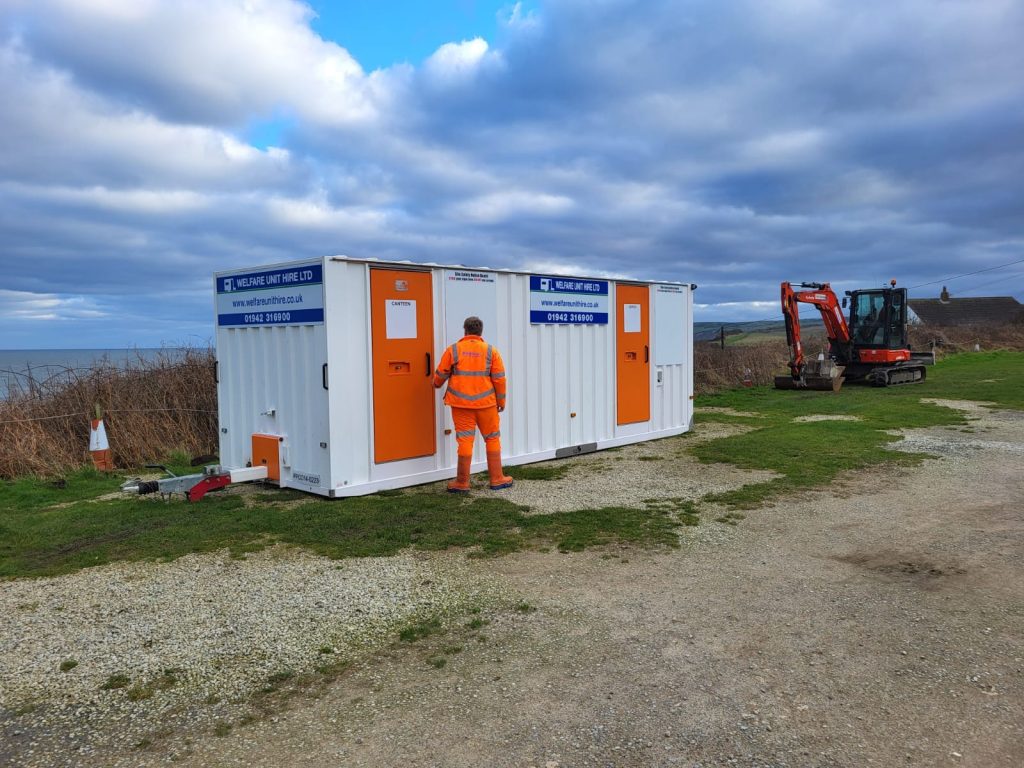
Towable, self-powered units are the practical answer when the work face moves every few days.
Plan the unit position and servicing access with your traffic management crew before the first closure goes in.
Share your phasing programme early and moves can be booked around shifts.
Why welfare is harder to get right on linear works
Schedule 2 of the CDM Regulations 2015 makes no exception for work that moves. Toilets, hot and cold washing, drinking water, somewhere warm to eat and a place to dry wet kit all have to be suitable, sufficient and reasonably close to where people are working. Our guide to HSE welfare requirements on construction sites sets out each duty in full.
On a linear scheme the usual answer falls apart quickly. A static cabin back at the compound can be a 20 minute drive from the work face. Crews end up relying on petrol stations and cafes, which rarely stands up as suitable and sufficient when an HSE inspector asks.
Every trip off site is also paid time with no metres laid.

What to look for in welfare unit hire for utilities and highways work
The unit needs to arrive behind one vehicle, set down in minutes and run without site services.
| What you need | Why it matters on linear works | How a Planet Power unit handles it |
|---|---|---|
| Tow and go | The work face moves every few days and a crane lift is not an option. | Road legal with VCA Type Approval and retractable suspension, so it tows in and lowers to the ground. |
| A small footprint | Space inside a lane closure, verge or lay-by is tight. | The Planet Power 6 body is 2.3m wide and under 3.7m long, yet seats four to six. |
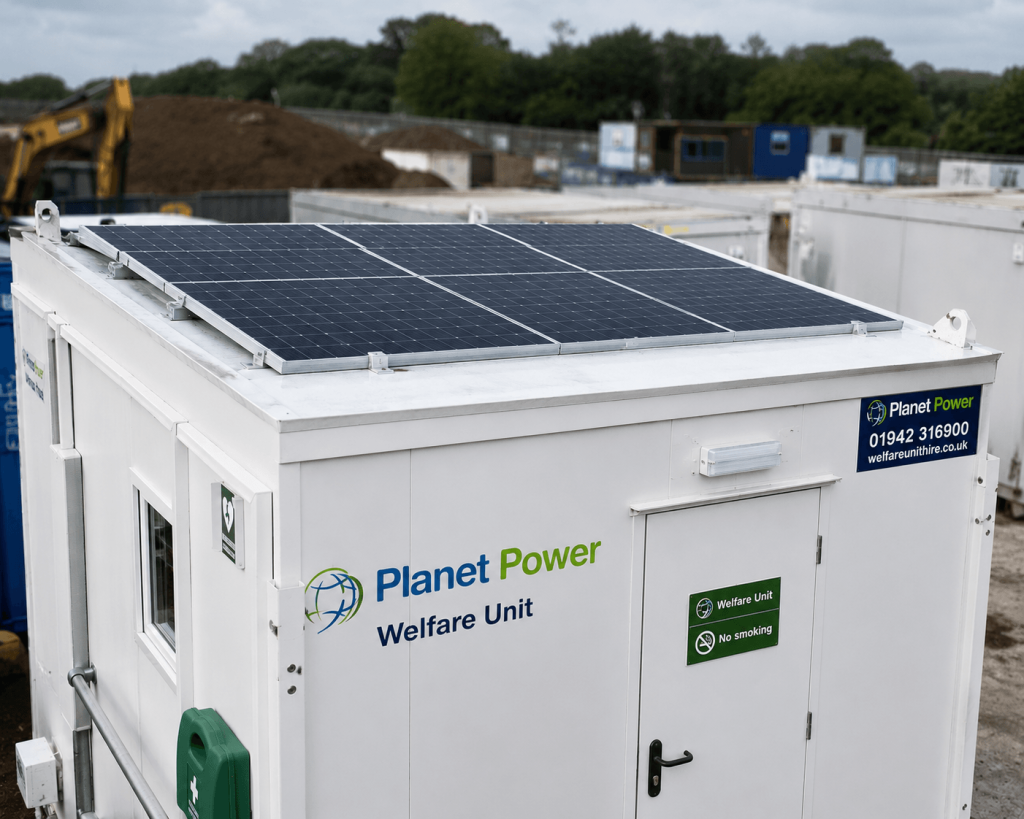
| No hook-ups | There is no mains power or water at the side of the A580. | Solar hybrid power with on-board water and waste tanks. Up to 75% cheaper to run than a generator only unit. |
| Security overnight | Units are often left at the roadside outside working hours. | Anti-vandal doors with three bolt locking and lockable window shutters. |
| Full provision in one unit | There is no room for a separate toilet, canteen and drying cabin. | Toilet with its own external door, hot and cold forearm washing, seating, kettle, microwave and a heated drying room. |
Solar hybrid power earns its place for another reason. The generator runs far less often, which matters outside people’s homes, and the fuel saving feeds into the carbon figures that utilities and highways frameworks now ask for. We covered the numbers in our piece on solar powered welfare units.
Working inside traffic management
On a live carriageway the welfare unit is part of the site layout, and the layout is governed by Chapter 8 of the Traffic Signs Manual and the Safety at Street Works and Road Works code of practice. Treat the unit as part of the traffic management design and agree these points with your TM crew early:
Where the unit sits in each phase, clear of the safety zone, sightlines and any footway that has to stay open.
How operatives walk to it without crossing live traffic.
How the servicing vehicle gets in and out of the works area, and at what time of day.
That last point is where suppliers differ. Our six 4×4 pickup mounted tankers are Chapter 8 decaled and run Euro V and VI compliant engines, so they are marked up for highway work and small enough to enter a closure without fuss. Four wheel drive also gets them down haul roads and pipeline easements. Each tanker carries a separate fresh water tank and pump, so clean water never shares pipework with waste. See Our Services for the detail.
Got a linear scheme coming up?
Send us the route, the crew size and the dates and we will recommend a towable unit and a servicing plan to match.
Use the enquiry formor call 01942 316900Repositioning units as the job moves
Moving welfare should never be the reason a gang stands idle. Give us your phasing plan at the start of the hire and we will book each move against it, timed for before the shift starts or after it ends so the crew always has facilities during working hours.
Because every unit lowers on its own suspension, a move is quick: raise, hitch, tow, set down. The servicing round is updated to the new location at the same time, and if the programme slips, one phone call resets the schedule.
Matching the unit to the gang
Most reinstatement, jointing and ducting gangs of up to six are well served by the Planet Power 6. Larger civils crews can step up to the Planet Power 8RD or Planet Power 10, both still towable. Where a scheme has a longer running base, such as a pumping station upgrade or a substation build, a Canteen Office 10 Twin Toilet gives the site manager a desk and the crew proper canteen space, while smaller units follow the satellite gangs.
Two add-ons are worth a look. The Mobile Tool Store and Drying Room keeps kit locked up at the roadside, and the Smart Pick suits terraced streets where even a six person unit will not fit. Our welfare unit size guide compares every model, and if you are weighing up running your own fleet, read welfare unit hire vs buying first.
A North West partner for North West frameworks
Utilities and highways programmes in this region run along the same corridors we do. From our single depot in Wigan, the M6, M62, M60, M61 and M58 put a unit on the ground in Manchester, Liverpool, Preston, Warrington or St Helens within 24 hours, and the same reach means a field engineer with spares on the van is never far from your works. We cover the North West only, by choice, which keeps servicing in-house and response times short. More on the Why Choose Us page.
Planning a phased project? Talk to our team about repositioning schedules
Tell us how your scheme is phased and we will plan the units, the moves and the servicing around it, and one of the team will come back to you today.
Fill in the enquiry formor call 01942 316900